Week11.1(5.13Mon)FREQUENTLY ASKED QUESTIONS(YANGPEIFU)

1. Summary

  Creative Commons (CC) provides free legal tools to facilitate the sharing and reuse of creativity and knowledge. Their licenses offer standardized terms for creators to license their works, encouraging reuse while retaining certain rights. CC also offers additional tools like CC0 and the Public Domain Mark. These resources are designed for global use and work seamlessly with the web.CC licenses are not anti-copyright; they are copyright licenses that specify usage rights while allowing creators to retain certain rights. They operate on material where copyright exists and do not affect exceptions and limitations to copyright. CC licenses are non-exclusive and do not cover other rights like trademark or patent rights. There are six core licenses, each with specific conditions like attribution, non-commercial use, no derivatives, and share-alike. Licensors can choose the appropriate license based on their preferences and intended use. The latest version, 4.0, is recommended for global enforceability, but ported licenses are available for specific jurisdictions.CC licenses grant permissions only for copyright and similar rights, and licensors waive or do not assert any moral, publicity, personality, or privacy rights they hold, to the extent necessary for the exercise of the licensed rights. Compliance with CC licenses is necessary, and licensors cannot insist on the exact placement of attribution. CC licenses are irrevocable, but rights under the license terminate if the licensee fails to follow the license conditions. Proper attribution is required when using CC-licensed material, and users should ensure their intended use complies with the specific license terms. CC licenses do not directly address plagiarism, and licensors have options to make money from works licensed under CC licenses. Overall, CC licenses provide flexibility and legal certainty for creators and users, promoting sharing and reuse while respecting copyright and other rights. 

2. Projet
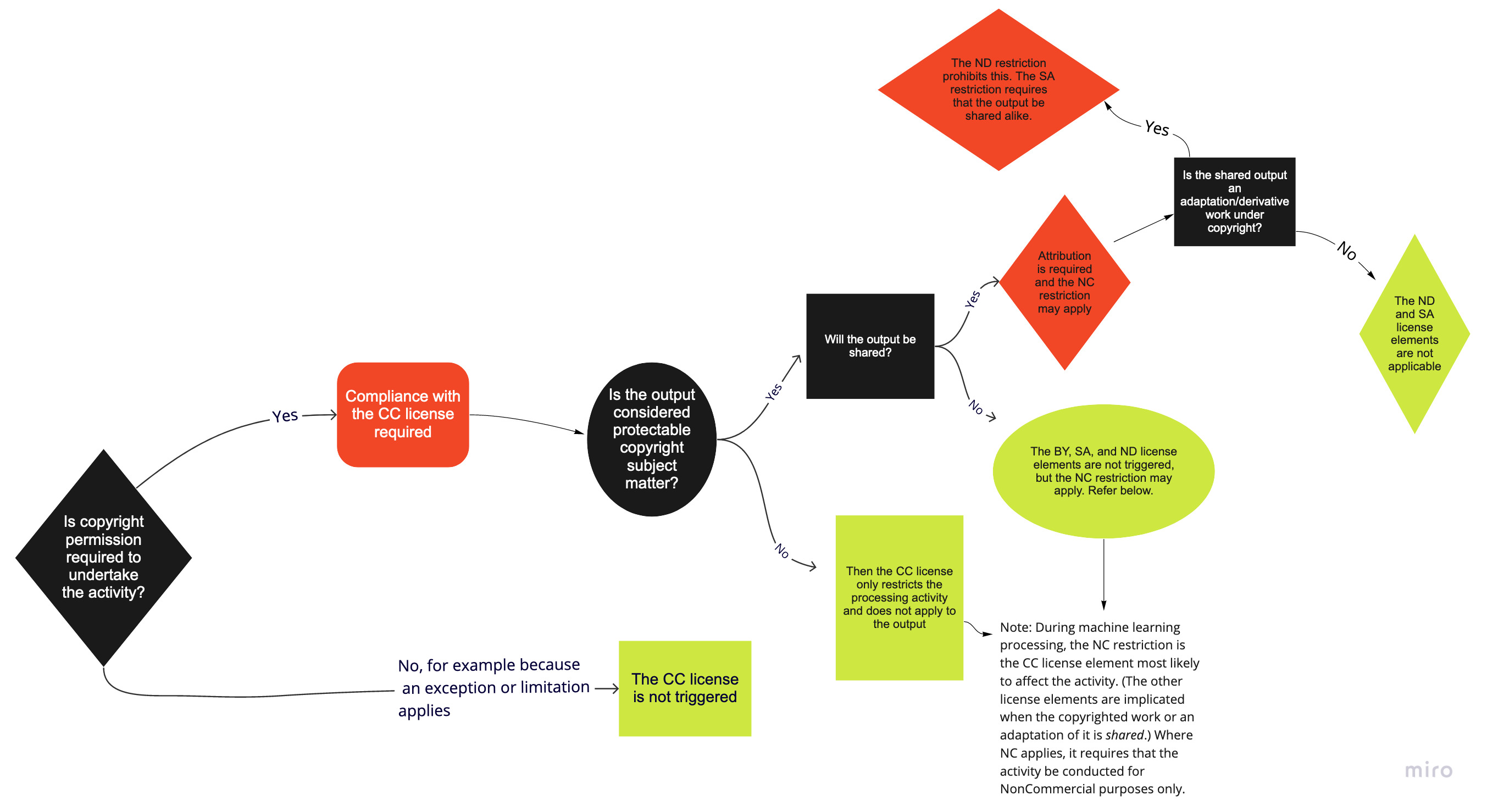
What are the limits on how CC-licensed works can be used in the development of new technologies, such as training of artificial intelligence software?

Creative Commons (CC) licenses grant permission for reuse of creative works under copyright, addressing the primary obstacle to reuse. They are carefully designed to work with all new technologies involving copyright without needing explicit permission. However, CC licenses do not address other legal issues like privacy laws, ethical research rules, or data protection laws, which must be respected separately from copyright issues. When including CC-licensed images in a published dataset, attribution obligations vary depending on the jurisdiction and context. In some cases, linking to the original image or URI may be sufficient, but compliance with license conditions is necessary if copyright (or sui generis database rights in the EU) is triggered.Regarding NonCommercial (NC) licenses, whether the NC restriction is violated depends on the intended use of the works by the company. If any uses are primarily intended for commercial advantage or monetary compensation, the NC restriction may be violated.For ShareAlike (SA) licenses, the entire database does not have to be licensed under an SA license. The SA condition only applies if a work is modified and shared publicly. The collection or compilation itself does not need to be made available under an SA license.If users dislike how their photos or images have been reused, several remedies may be available. They can request removal of attribution or pursue claims for copyright infringement if license terms have been violated. However, it's essential to understand CC licenses and other relevant laws before sharing content under these licenses.
3. Question
"What types of uses are considered primarily for commercial advantage or monetary compensation when using images licensed under the NonCommercial (NC) restriction?"


Comments

Popular posts from this blog

W4.1 March 25 (Mon)——LI MENGRU

W10.2 May 10 (Fri)—CHENG SHIYI

W1.1 Intro class: intro to class, blog, wiki and other assignments——CHENG SHIYI